Context Engineering for Vibe Coding: Structured Prompts for Rapid SaaS Prototyping
Context engineering structures the full data environment for LLMs in vibe coding, turning vague ideas into reliable SaaS prototypes. This 2026 discipline reduces errors via retrieval, memory, and policies, ideal for scaling AI-assisted development. CTOs gain workflows and tradeoffs for immediate productivity gains.

Context Engineering for Vibe Coding: Structured Prompts for Rapid SaaS Prototyping
Executive Summary
In AI-assisted development, vague natural language descriptions—termed "vibe coding"—often fail to produce reliable, production-ready code due to inconsistent model interpretations and missing architectural constraints. Context engineering addresses this by systematically curating the full information environment provided to large language models (LLMs), including retrieved data, prior actions, system state, and policies, transforming ad-hoc prompts into scalable workflows.
This approach matters in 2026 as enterprises scale AI from one-off prototypes to multi-turn agentic systems handling complex SaaS features, where prompt engineering alone lacks mechanisms for memory, compliance, and multi-user consistency. CTOs and technical leads in mid-stage SaaS companies benefit most, reducing iteration cycles from days to hours while maintaining reliability.
The article provides architectural patterns, a realistic case study, implementation workflows, and tradeoffs for integrating context engineering into development pipelines.
What is Context Engineering?
Context engineering shifts focus from crafting individual prompt strings (prompt engineering) to designing the entire data environment visible to the model at inference time. It determines what information the model consumes—such as retrieved documents, tool definitions, conversation history, or system policies—how it is selected and structured (e.g., via retrieval pipelines or templates), and how it refreshes dynamically (e.g., through feedback loops or state updates).
Unlike prompt engineering, which is limited to a single text input, context engineering leverages existing infrastructure like search indexes, databases, and APIs to ground outputs, reducing hallucinations by ensuring responses are anchored in authoritative data. For vibe coding—where developers describe high-level ideas like "build a user dashboard with real-time analytics"—context engineering injects specifics such as API schemas, styling guides, and deployment constraints to guide the model toward coherent implementations.
Core Pillars of Context Engineering
Context engineering rests on four pillars:
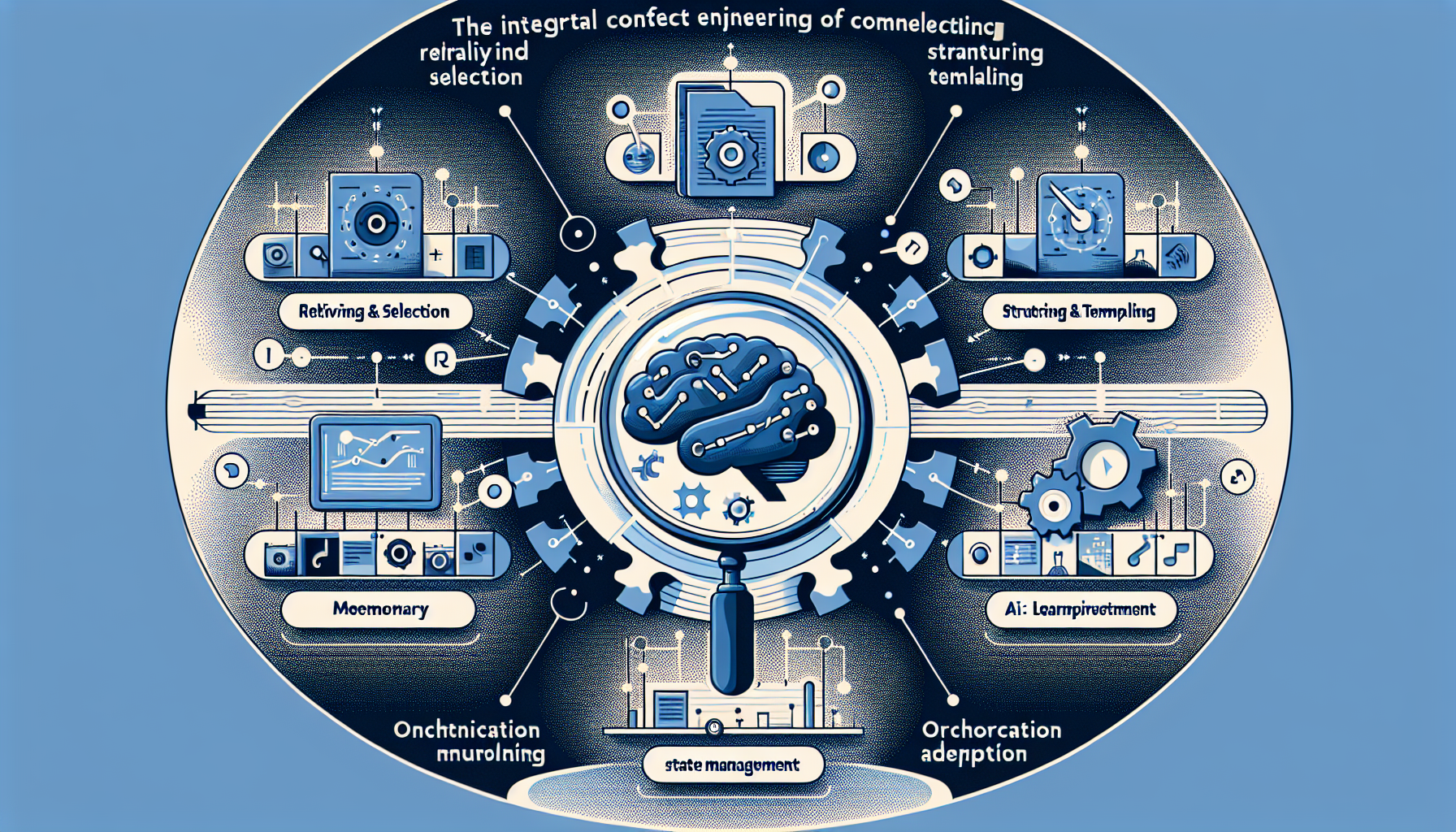
These pillars enable vibe coding to scale from single prototypes to agentic workflows that autonomously refine code based on evolving requirements.
Vibe Coding: From Vague Ideas to Structured Contexts
Vibe coding refers to conversational AI coding where developers express intents in natural language, relying on the model to infer details. Without structure, this leads to brittle outputs: incomplete architectures, ignored edge cases, or misaligned tech stacks. Context engineering elevates this by pre-loading the model's "view" with constraints and assets.
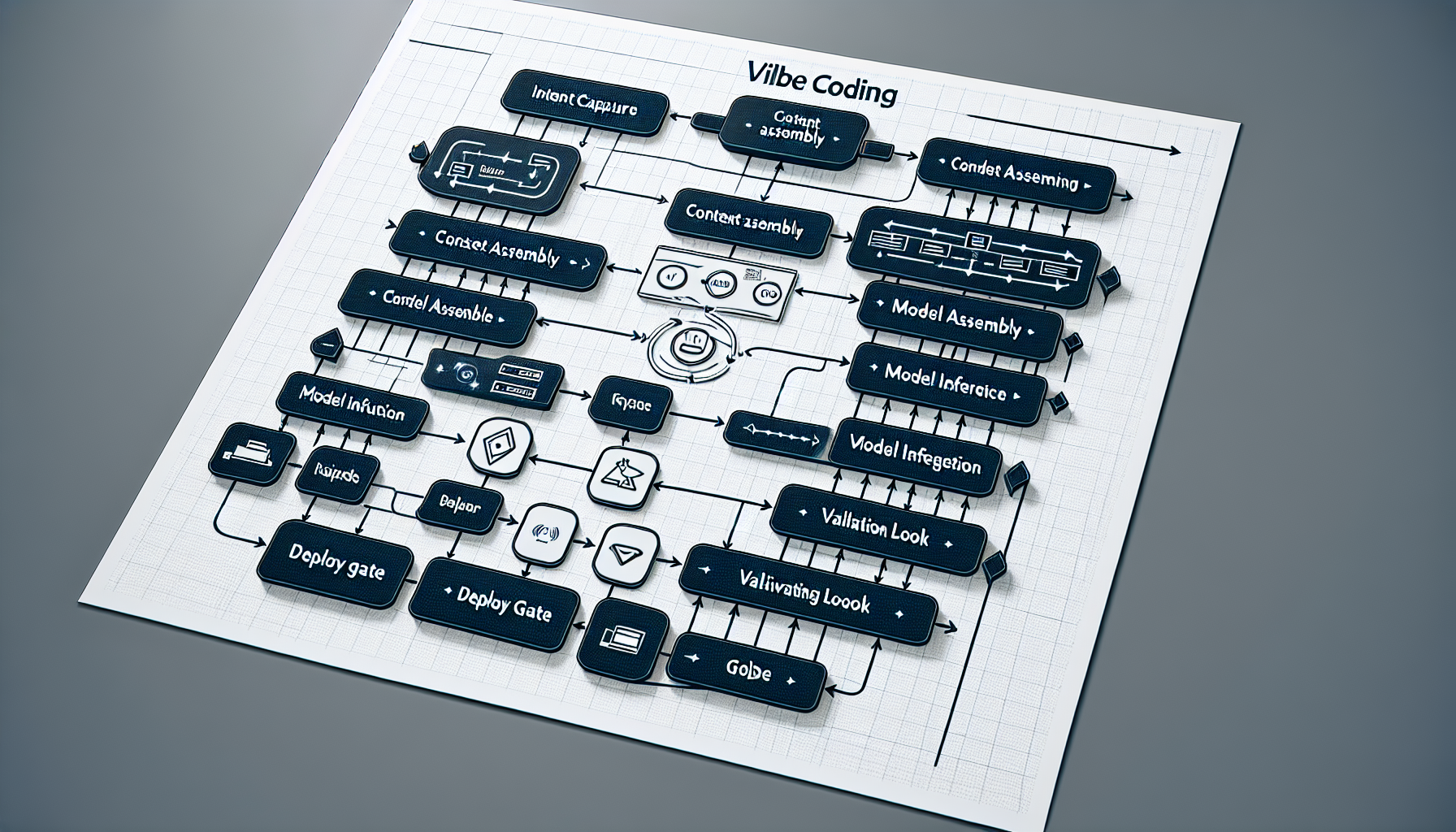
Reference Workflow for Vibe Coding
This workflow turns a 200-word vibe into a full-stack prototype by ensuring the model "sees" production realities upfront.
Case Study: Rapid Prototyping of a SaaS Analytics Dashboard
Context and Goals
A mid-sized SaaS company (50 engineers, $20M ARR) needed to prototype a customer-facing analytics dashboard for subscription metrics. Constraints included AWS hosting, PostgreSQL backend, React frontend, and SOC2 compliance. Goals: Validate MVP in one week, integrate real-time data from Kafka streams, support 10k users.

Stack and Tools
Step-by-Step Workflow
Failure Mode: Initial generation omitted auth middleware, failing SOC2 scan. Detected via automated diff validation; mitigated by injecting auth policy explicitly in context, reducing retries by prioritizing structured rules over free-form vibe.
Outcomes and Lessons
Operationally, prototype lead time dropped from 2 weeks (manual) to 3 days, with clearer handoffs due to generated docs. Copy: Layered context templates for reuse. Avoid: Over-relying on retrieval without token budgeting—early runs hit 128k limits, fixed by hybrid keyword+vector search.
Practical Implementation: Context Pipeline Architecture
Component Breakdown
Textual flow: Developer Vibe -> API Gateway -> Context Assembler (retrieve + template) -> LLM Orchestrator -> Sandbox (test exec) -> Policy/Validation -> Approval Gate -> Code Repo -> CI/CD.
Pseudo-Code for Context Assembly
class ContextEngineer:
    def __init__(self, retriever, template_engine):
        self.retriever = retriever  # e.g., Pinecone
        self.template = template_engine    def assemble(self, vibe: str, history: list, repo_id: str) -> str:
        # Pillar 1: Retrieval
        docs = self.retriever.query(vibe, repo_id, top_k=5)
        # Pillar 2: Structuring
        ctx = self.template.render({
            'system': 'Follow AWS Well-Architected Framework; use TypeScript.',
            'history': history[-10:],  # Memory management
            'retrieved': docs,
            'vibe': vibe
        })
        # Pillar 4: Token check
        if len(ctx) > MAX_TOKENS:
            ctx = self.truncate(ctx)
        return ctx
This critical path ensures vibe inputs map to bounded, relevant contexts.
Challenges and Constraints
Technical Bottlenecks
Context length limits (e.g., 128k-1M tokens) force prioritization; poor retrieval yields irrelevant noise, increasing latency (200-500ms/query). Data quality issues, like outdated repos, propagate errors—mitigate with freshness metadata in indexes.
Cost Implications
Inference dominates (e.g., $0.01/1k tokens at scale); retrieval adds egress fees. Observability (tracing pipelines) overhead: 20-30% extra compute. Human-in-loop for gates adds ops cost but prevents bad deploys.
Organizational Friction
Skills gaps: Need "context specialists" for pipelines, per 2026 trends. Ownership: Devs vs. platform teams? Security reviews slow rollouts—address via self-service sandboxes.
Adoption Risks
Vendor lock-in from proprietary retrievers; model drift requires retraining embeddings quarterly. Shadow IT from unchecked vibe tools; mitigate with centralized orchestrators. Leadership expectations for instant wins ignore iteration needs.
Actionable Takeaways
FAQ
What is context engineering in AI development?
Context engineering in AI development involves designing the entire data environment visible to a model at inference time. It focuses on determining what information the model consumes, how it is selected and structured, and how it refreshes dynamically. This approach helps reduce hallucinations and ensures responses are anchored in authoritative data.
How does context engineering improve vibe coding?
Context engineering improves vibe coding by pre-loading the model's view with constraints and assets, transforming vague natural language descriptions into structured contexts. This ensures the model has access to relevant information like API schemas and deployment constraints, leading to more coherent and production-ready code outputs.
What are the core pillars of context engineering?
The core pillars of context engineering are retrieval and selection, structuring and templating, memory and state management, and orchestration and adaptation. These pillars help dynamically fetch relevant data, organize context efficiently, persist multi-turn state, and sequence context updates across agent steps.
How does context engineering help in rapid SaaS prototyping?
Context engineering helps in rapid SaaS prototyping by reducing iteration cycles from days to hours while maintaining reliability. It allows for the systematic curation of the information environment provided to models, enabling them to produce reliable, production-ready code for complex SaaS features.
What challenges are associated with context engineering?
Challenges associated with context engineering include technical bottlenecks like context length limits, which force prioritization, and data quality issues that can propagate errors. There are also cost implications due to inference and retrieval fees, and organizational friction due to skills gaps and security reviews.
Related reading
Maksym Tytarenko
AI & SaaS Development Expert at Tytarenko AI Agency
Related Articles
AI Automation Architectures for Bootstrapped SaaS: Open-Source Patterns to Match Enterprise Scale
Bootstrapped SaaS teams can deploy open-source AI architectures—data, orchestration, agent layers—to automate marketing, support, and ops at $100/month, matching VC-scale efficiency. Detailed patterns include RAG workflows, CrewAI orchestration, and safety gates with tradeoffs in latency and cost. CTOs gain concrete implementations to reduce solo ops overhead.
6 min readAI & MLAdding a second model to my agent fleet: the wiring was the cheap part
A second model went onto my autonomous coding fleet with one environment swap. The expensive work was deciding who reviews whom, and three defects the diff could not show me.
9 min readAI & MLUnknown Is Not Clean: Metrics for Code Your Agents Write
Ninety-nine percent of what a coding-agent fleet burns is re-reading, not writing. Here is the metric set I built to see what that spend actually buys, and the five rules it taught me, starting with the one that made my first clean-looking report a lie.
9 min readReady to Build Your AI-Powered Solution?
Let's discuss how we can help you leverage AI to transform your business.
Get in Touch