Enhancing Code Review Reliability with a Multi-Pass Fan-Out Reviewer Strategy
A production report from an autonomous agent fleet: why single-pass AI code review has high variance, and how N independent fan-out passes with unioned blocking findings fixed it - with measured precision, real costs, and honest limits.

TL;DR
critical-labeled PRs fan out; routine diffs stay single-pass.Executive Summary
When I put an AI reviewer in charge of gating merges for my autonomous coding fleet, I hit a reliability gap that no prompt tweak could fix: single-pass reviews had high variance in what they caught.
The same model, run twice on the same pull request, would surface different bugs. A mid-tier model would sometimes flag a critical defect that a top-tier model had walked past. One pass never reliably covered every critical module.
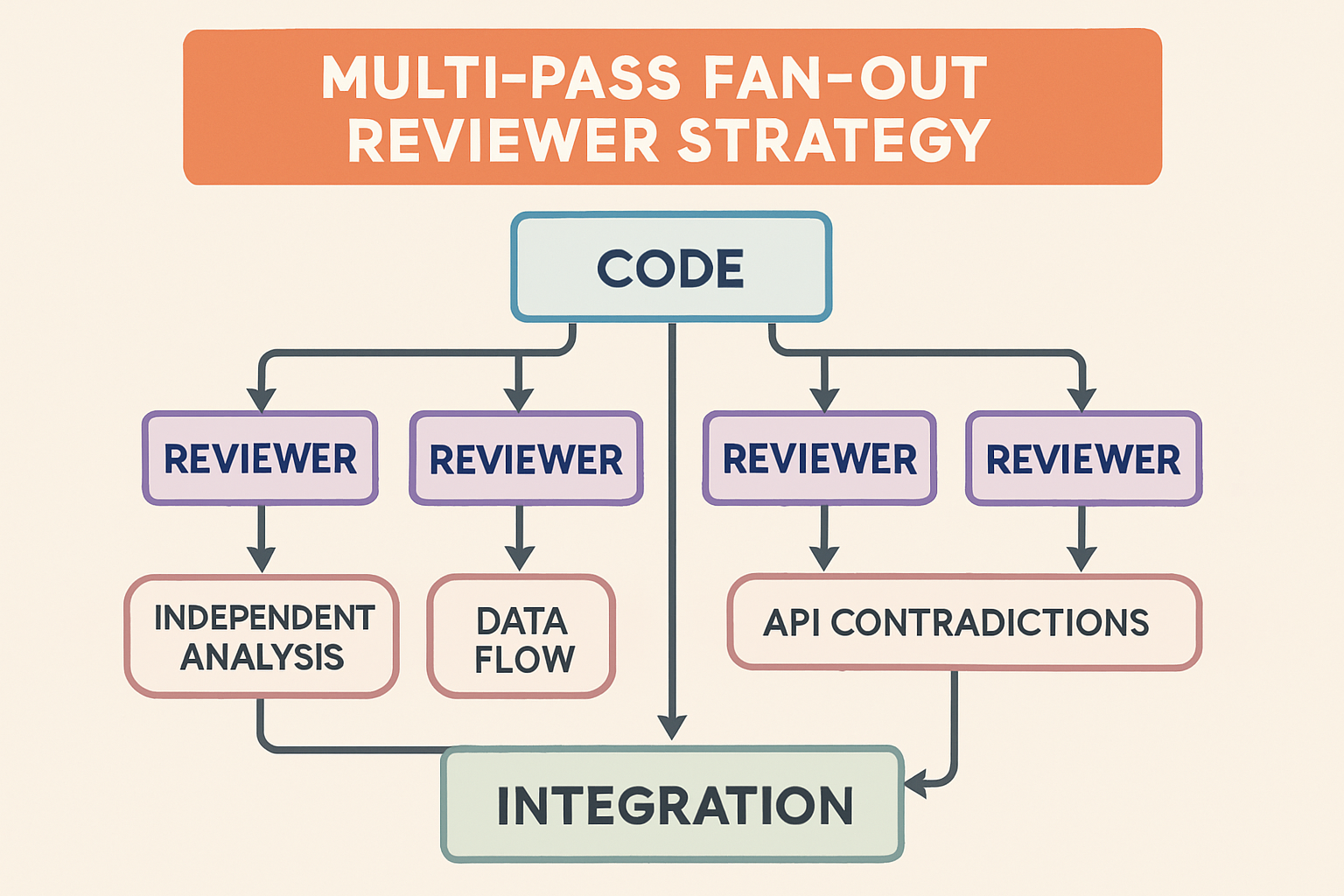
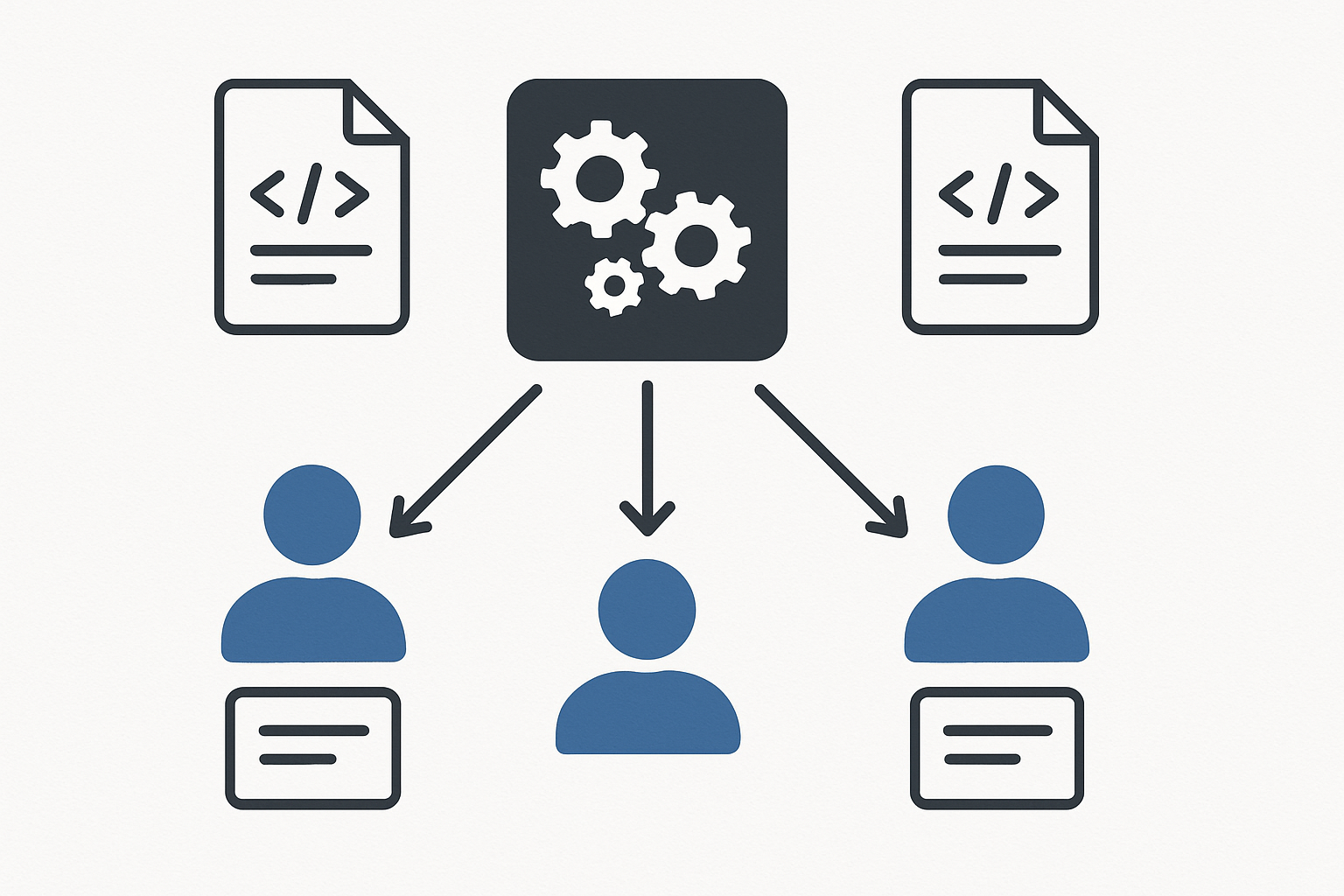
The structural fix was a multi-pass fan-out reviewer: for high-risk PRs, several independent reviewer instances each review the full diff from a clean context, and their blocking findings are unioned before the merge decision.
This article is for CTOs, technical product leaders, and senior engineers wiring agentic coding into production pipelines. It covers the real architecture, the empirical data that forced it, what it costs, and where it is not worth it.
The Self-Review Trap: Why Single-Pass Review Fails
The naive setup is letting the agent that wrote the code review it in the same session. That fails structurally, not accidentally.
A session that just generated code retains the entire reasoning context that produced it. The model sees the diff not as an artifact to critique but as the conclusion of its own chain of thought, so it rationalizes the same edge cases it missed while writing.
The first structural improvement is obvious: review in a fresh context, with no knowledge of the task framing or the builder's reasoning. Every serious agentic pipeline does this today.
The less obvious problem is that even a fresh, independent single pass is not enough. That is what my production data showed — and that is what the rest of this article is about.
What the Variance Data Showed
My autonomous fleet (an agent corporation that claims issues from a board, builds PRs in containers, and passes them through an AI review gate before I see them) logs every review verdict. Two observations from those logs forced the redesign:
The practical conclusion: one pass never reliably covers a critical module; two to three independent passes do. Review coverage had to be treated statistically — you don't fix a sampling problem with a better prompt, you fix it with more samples.
Architecture of the Multi-Pass Fan-Out Reviewer
Here is the actual production flow, end to end:
PR opened by builder agent
  → risk gate: Priority=High OR critical label?  — no → single review pass
  → yes: N independent review passes over the FULL diff
         (fresh container + fresh context each; no shared state)
  → union of findings through the severity gate:
         a finding is BLOCKING if ANY pass raises it as blocking
  → cycle 2+ (after fixes): single pass with "verify my findings"
         + a delta-diff skeptic reviewing only what changed
  → cross-vendor skeptic pass (a different provider's model)
  → human merge gate: Merge / Revise / Reject buttons in Telegram
Design decisions worth stealing:
Full-PR passes, not per-file splitting. Each pass reviews the whole diff with repository access. Cross-file bugs — a signature change breaking a caller elsewhere — are exactly the class single passes miss most, so scoping a reviewer down to one file would throw away the highest-value signal.
Union, not consensus. Passes do not vote. If one reviewer out of three flags a real blocking defect, that defect exists regardless of how the other two sampled the diff. Consensus mechanisms optimize for agreement; merge gates must optimize for recall on blocking issues. Noise from unioning is handled downstream by a severity gate and the fix-verify cycle, not by discarding minority findings.
Fan-out only on cycle 1. After the builder addresses findings, later cycles review a much smaller delta. There, a single pass with two focused jobs — re-verify the original findings, and skeptically review only the changed lines — is enough. Fanning out every cycle would multiply cost with little added recall.
Cross-vendor skeptic as a separate, single pass. Same-vendor passes can share blind spots. A final skeptic pass by a different provider's model attacks the PR from outside that correlation. It stays single-pass: its job is diversity, not sampling.
Configuration over hard-coding. Fan-out ships off by default (REVIEW_FANOUT=1), with a global cap and a per-task label override (review-fanout:N) in both directions. Per-pass agreement is logged to a metrics file so N can be tuned from data instead of vibes.
Single-Pass vs Multi-Pass Fan-Out
| Dimension | Single independent pass | Multi-pass fan-out (N=3) |
|---|---|---|
| Coverage of critical modules | Varies run to run | Union of 3 samples — far fewer gaps |
| Same-model blind spots | Unmitigated | Reduced by independent sampling |
| Cross-vendor blind spots | Unmitigated | Handled by a separate skeptic pass |
| Blocking-finding recall | One sample's worth | Any-of-N: strictly higher |
| Review cost (cycle 1) | 1× | ~N× |
| Wall-clock (cycle 1) | 1× | ~N× when passes run sequentially |
| Right scope | Routine diffs, later cycles | High-risk PRs, critical modules |
Case Study: The Agent-Corp Merge Gate
Context. My agent fleet ("agent-corp") runs autonomously: agents claim issues from a task board, build in isolated containers on a single small cloud VM (an e2-small class machine costing around $5/month), open PRs, and every PR passes an AI review gate before reaching me. The reviewer is not advisory — it decides whether a PR is merge-ready, and I confirm with one tap.
Trigger. The variance observations above came from this fleet's own review logs, reported in its daily digests on two consecutive days. Once two independent daily reports agreed that single passes were missing critical findings, the fan-out redesign became a board issue like any other feature.
Implementation. The fan-out reviewer shipped as one PR built by the fleet itself: risk-gated N-pass fan-out on cycle 1, union of blocking findings into the existing severity gate, config knobs and label overrides, and per-pass agreement logging. The change landed with the full test suite green — 779 tests, 20 of them new for the fan-out logic.
One honest engineering constraint. The passes run sequentially, not in parallel. Each task's container identity is keyed on the repository and PR number, and the fleet's crash-recovery machinery assumes one container per task. Parallel passes would collide with that identity scheme. Sequential execution costs wall-clock but preserves a recovery model that has already survived real worker restarts — a classic case of a boring constraint beating an elegant diagram.
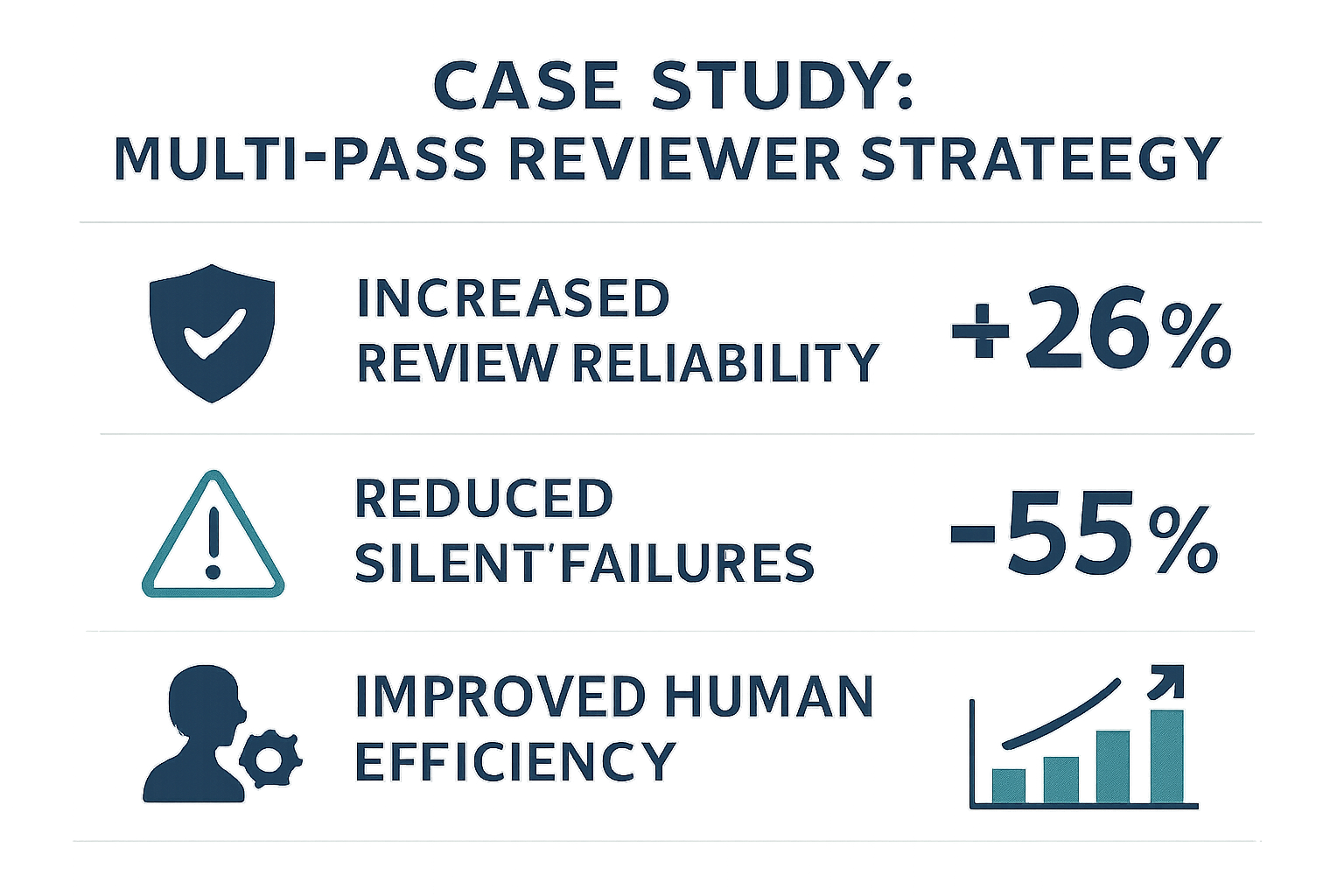
Measured precision. Before trusting the gate further, I backtested the reviewer's verdicts against my own Merge/Revise/Reject decisions. Of 61 agent-built PRs, 17 (those with structured review-state markers) could be attributed to a specific human decision without guessing. On those 17 multi-file PRs the reviewer showed 94% precision — 16 clean merges, 1 revise.
The decision the data did NOT support. The same backtest was meant to find PR classes safe for auto-merge (docs-only, additive tests, config bumps). The attributable sample contained zero PRs in those classes — so auto-merge stayed off. Not because the bar was failed, but because the evidence didn't exist yet. Directional numbers from small samples are for steering, not for removing safety gates.
Practical Implementation Layer: The Orchestration Logic
The core loop is small. This pseudo-code mirrors the real structure — sequential passes, findings union, severity gate:
def review_cycle_1(pr, settings):
    # Risk gate: routine diffs stay single-pass (cost control).
    n_passes = settings.review_fanout if pr.is_high_risk() else 1
    n_passes = min(n_passes, settings.review_fanout_max)    all_findings = []
    for i in range(n_passes):
        # Fresh container + fresh context per pass: the reviewer must not
        # see the builder's reasoning or the previous passes' findings.
        with fresh_review_container(pr) as reviewer:
            findings = reviewer.run_full_review(pr.diff)
            log_pass_agreement(pr, i, findings)   # tune N from data later
            all_findings.extend(findings)    # Union through the severity gate: BLOCKING if ANY pass says blocking.
    merged = severity_gate.union(all_findings)
    return decide_merge_readiness(merged)
def review_cycle_2_plus(pr, prior_findings):
    # The diff shrank; sampling is no longer the bottleneck.
    with fresh_review_container(pr) as reviewer:
        verified = reviewer.verify_findings(prior_findings)
        delta = reviewer.skeptic_review(pr.delta_diff_only())
    return decide_merge_readiness(verified + delta)
Two properties do the heavy lifting: fresh context per pass (independence is the whole point) and union semantics (recall over agreement). Everything else is plumbing.
Cost and Latency: What Fan-Out Actually Costs
The arithmetic is unforgiving and worth stating plainly.
A useful frame for the budget conversation: compare N× review inference against the cost of one bad merge reaching production — the revert, the incident, the trust damage. For critical paths, the review passes are the cheap side of that inequality.
Limitations: Where Fan-Out Is Not Worth It
Actionable Takeaways
FAQ
How much does a multi-pass fan-out review cost compared to single-pass?
Roughly N times the cycle-1 review inference — with N=3, about three times. Later fix-verify cycles stay single-pass, and routine PRs never fan out, so the multiplier hits only high-risk work. Weigh it against the cost of one bad merge reaching production.
Why can't the AI just review its own code in the same conversation?
A session that wrote the code retains the reasoning that produced it, so it critiques its own conclusions with its own assumptions — confirmation bias by construction. Independent review requires a fresh context that has never seen the task framing or the builder's chain of thought.
Why take the union of findings instead of majority voting?
Because a real blocking bug found by one pass out of three is still a real blocking bug. Voting optimizes for agreement and silently drops minority findings — exactly the rare, hard-to-see defects fan-out exists to catch. Handle the extra noise downstream with a severity gate, not by discarding findings.
Do multiple passes of the same model actually find different bugs?
Yes — that observation is what motivated this architecture. In my fleet's logs, two runs of the same model on the same diff produced different findings, and a mid-tier model caught critical bugs a top-tier model missed. Review coverage behaves like sampling, so more independent samples raise recall.
Do I need different models for the builder and the reviewer agents?
Fresh, independent sessions matter more than different models: same model, clean context, no shared reasoning already removes the self-review trap. Different vendors add a second, distinct benefit — decorrelating family-level blind spots — which is why a single cross-vendor skeptic pass sits at the end of my pipeline.
Related reading
Sources
Maksym Tytarenko
AI & SaaS Development Expert at Tytarenko AI Agency
Related Articles
Two Green Pull Requests, One Red Main: The Stale Merge Ref
Two of my agent fleet's pull requests passed CI, then their merge turned main red and blocked every open pull request. Git saw no conflict, because there was none: one branch made a function argument required, the other added a call site that the first branch's tree never contained. A walk through the stale merge ref, the diagnosis I got wrong, the convenient fix I refused, and the merge rule I now follow.
12 min readSaaS DevelopmentMicro-SaaS Automation Architectures: AI Patterns for Solopreneur Scalability
This guide provides AI architectures for micro-SaaS solopreneurs, focusing on SLMs, on-device deployment, and agentic workflows with governance. Learn reference patterns, implementation code, and tradeoffs for scalable automation in lead gen, reviews, and compliance. Ideal for CTOs building low-overhead revenue systems in 2026.
6 min readAI & MLA Verdict With an Expiry Date: Making AI Eval Results Ask to Be Re-Measured
This article discusses the importance of setting expiry dates for AI evaluation results to ensure timely re-assessment. It highlights the risks of stale recommendations in autonomous systems and proposes a new convention for documenting re-measurement timelines.
15 min readReady to Build Your AI-Powered Solution?
Let's discuss how we can help you leverage AI to transform your business.
Get in Touch