The Vibe Coding Playbook: Turning Fuzzy Ideas into Shippable Features in 48 Hours
A practical, end-to-end playbook for converting vague stakeholder requests into validated, shippable features using Vibe Coding in 48 hours.

Introduction: From Vague Requests to Working Software in 48 Hours
Every CTO, tech lead, and founder has heard some version of this:
“Can we just add something so sales can see all the important stuff about a customer on one screen?”
It’s fuzzy. It’s urgent. And it’s headed straight toward your backlog.
In a traditional cycle, this turns into weeks of clarification meetings, specs, tickets, and handoffs before anyone touches code. Vibe Coding flips that script.
Vibe Coding is an AI-assisted approach where you describe what you want in natural language and let an LLM generate the bulk of the implementation, while you guide, test, and refine. Used well, it’s a rapid product discovery and delivery engine, not just a fancy autocomplete.
This playbook walks through a repeatable 48-hour pipeline for turning vague stakeholder requests into working, validated features:
Along the way, we’ll highlight where human judgment is non-negotiable—because speed without judgment is just a faster way to ship the wrong thing.
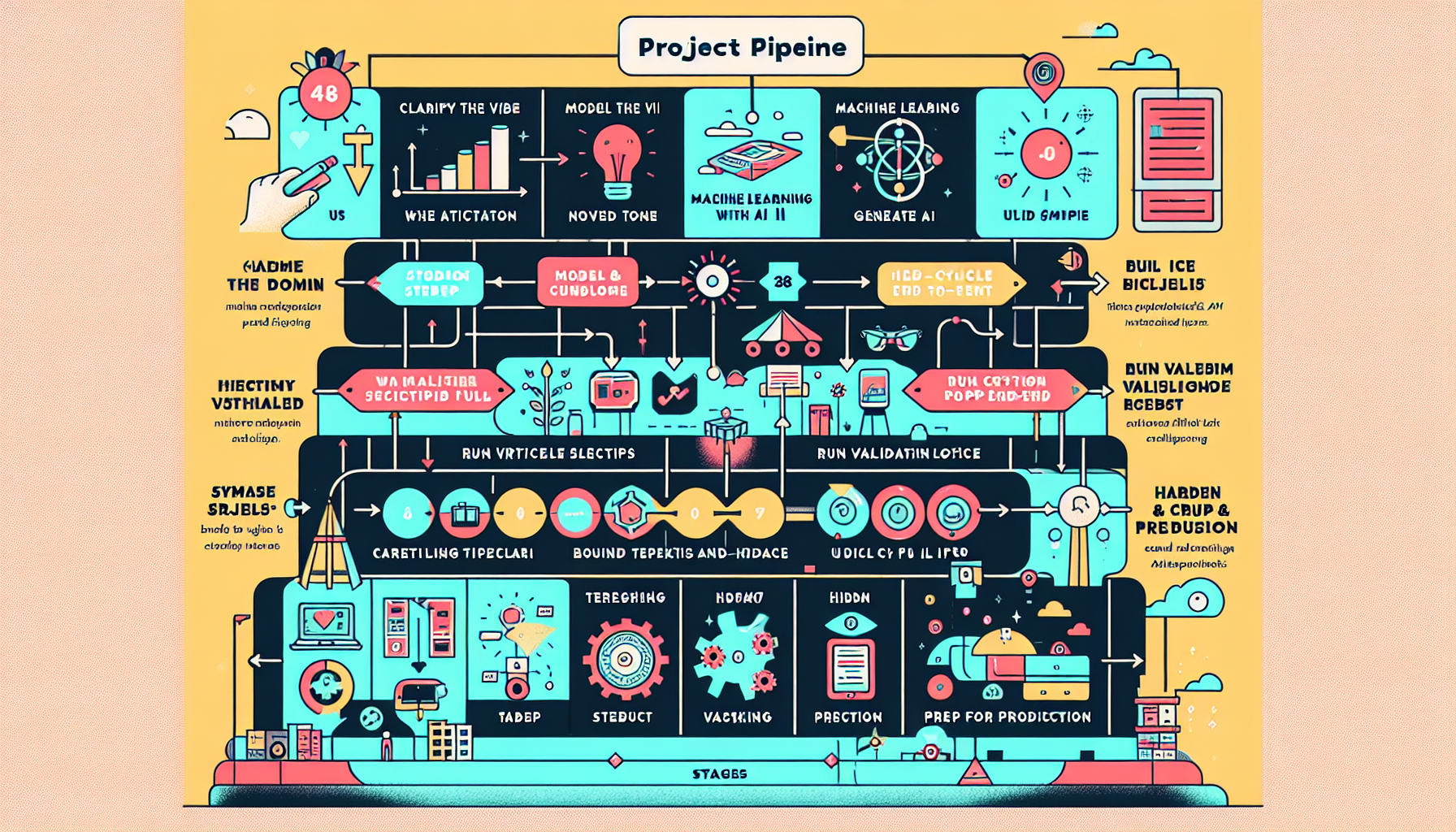
The 48-Hour Vibe Coding Pipeline (Overview)
Here’s the high-level flow you can run in a 1–2 day feature sprint:
Transform the fuzzy idea into a concise product intent and constraints via prompt-first ideation.
Use an LLM to explore entities, relationships, workflows, and edge cases.
Have the AI propose flows, wireframes, and starter components.
Database → API → UI → basic tests, using AI for code generation and you for orchestration and review.
Put the prototype in front of real users; capture feedback; iterate quickly.
Security, performance, logging, and team documentation.
You don’t need to follow the timeboxes literally, but they force the right trade-offs: scope small, validate early, and let AI handle the heavy lifting while humans guard correctness, risk, and product sense.
Step 1: Prompt-First Ideation – Turning Vibes into Clear Intent
The Problem
Stakeholder requests are often:
Vibe Coding doesn’t mean “skip thinking and just prompt.” It means use prompts as a structured thinking tool.
The Goal
In 60–90 minutes, produce a crisp, shareable intent artifact:
This acts as your Product Requirements Draft (PRD) for both humans and the AI.
Example Prompt: Clarifying a Fuzzy Request
Stakeholder input:
“Sales needs a better view of customer health. Right now they’re blind.”
Prompt to your LLM:
You are a senior product manager.I’ll paste a vague stakeholder request. Your job is to:
Extract the underlying business problem
Identify the primary user roles
Propose 3–5 measurable success metrics
List assumptions that must be validated with users
Suggest a concise problem statement (max 3 sentences) Stakeholder request:
"Sales needs a better view of customer health. Right now they’re blind."
Return your answer in structured Markdown with headings.
In 1–2 iterations, you’ll have a draft problem framing you can quickly review with the stakeholder.
Where Human Judgment Is Critical
A disciplined upfront prompt round saves multiple days of rework downstream. A tightly scoped hero workflow really does ship — our tic-tac-toe Unity build went from a one-line idea to playable in the browser inside a single agent task.
Step 2: AI-Assisted Domain Modeling – Understand Before You Build
With the intent clear, you shift to domain modeling: entities, relationships, workflows, and edge cases. Vibe Coding excels here because LLMs are strong at exploring permutations you may overlook.
Outputs You Want
Example: Domain Modeling Prompt
You are a staff-level backend engineer.We are designing a "Customer Health Overview" feature for sales reps.
Context:
Users: B2B account executives
Goal: Help them prepare for renewal / upsell calls in under 3 minutes
Data sources: CRM accounts + product usage + support tickets Tasks:
Propose a domain model: entities, fields, and relationships.
Suggest a normalized relational schema suitable for PostgreSQL.
List 10 realistic edge cases or data quality issues.
Propose 3 core API endpoints to power a single-page dashboard. Return: Markdown with sections and code blocks for SQL schema.
Example of AI-generated schema (truncated):
CREATE TABLE accounts (
  id UUID PRIMARY KEY,
  name TEXT NOT NULL,
  segment TEXT NOT NULL,
  renewal_date DATE,
  owner_id UUID NOT NULL
);CREATE TABLE health_signals (
  id UUID PRIMARY KEY,
  account_id UUID REFERENCES accounts(id),
  source TEXT NOT NULL, -- "product_usage", "support", etc.
  score INTEGER NOT NULL CHECK (score BETWEEN 0 AND 100),
  description TEXT,
  created_at TIMESTAMPTZ DEFAULT now()
);
Where Human Judgment Is Critical
The domain model becomes the source of truth you’ll feed into subsequent prompts.
Step 3: Rapid UI Scaffolding – From Words to Screens
Once you know what you’re modeling, you can move to how users experience it. Vibe Coding lets you go from zero to reasonable UI scaffolds in hours.
Outputs You Want
Example: User Flow & Wireframe Prompt
You are a senior UX designer and front-end engineer.We’re building a "Customer Health Overview" page as a single-screen dashboard.
Users: B2B account executives.
Goal: In under 3 minutes, understand risk level and plan next best actions.
Tasks:
Describe the ideal user flow in 5–10 steps.
Propose a layout using a text-based wireframe.
List the React components we should implement.
Generate a basic React + TypeScript implementation using a Tailwind-based layout. Limit JS code to the layout and mock data. No API integration yet.
Example of AI-generated React scaffolding (simplified):
import React from "react";const mockAccount = {
name: "Acme Corp",
segment: "Enterprise",
healthScore: 72,
riskLevel: "Medium",
};
export function CustomerHealthOverview() {
return (
{mockAccount.name}
Segment: {mockAccount.segment}
Health Score
{mockAccount.healthScore}
{mockAccount.riskLevel} Risk
{/ TODO: usage charts, support tickets, next best actions /}
);
}
Where Human Judgment Is Critical
At this point—often by the end of Day 1—you should have a clickable mock UI with mock data that you can already demo.
Step 4: Vertical-Slice Implementation – Ship One End-to-End Path
To avoid getting lost in breadth, use a vertical slice approach: build a thin, fully working path instead of a half-done system.
For example, choose:
Structured Plan Prompt
Before coding, have the AI help you structure the work:
You are a staff engineer helping plan a vertical-slice implementation.Context:
Feature: Customer Health Overview dashboard
Tech: React + TypeScript frontend, Node.js + Express backend, PostgreSQL
Constraint: We want a shippable slice in 48 hours. Tasks:
Break work into 5–7 phases, each delivering a testable end-to-end increment.
For each phase, specify:
Goal
Changed components (DB, API, UI)
Acceptance criteria
Assume we start from the mock UI and draft schema. Return as a Markdown table.
Review and slightly edit the plan, then execute phase by phase.
Example: AI-Assisted Backend Implementation
Prompt:
You are a senior backend engineer.Using the PostgreSQL schema below, generate a minimal Express + TypeScript API with:
GET /accounts/:id/health -> returns account summary + aggregated health score Requirements:
Use async/await
Use parameterized queries to prevent SQL injection
Include basic error handling
No ORM, use node-postgres (pg) client Schema:
CREATE TABLE accounts (...);
CREATE TABLE health_signals (...);
Return a single TypeScript file named accountHealthRoute.ts.
Example output (abbreviated):
import { Request, Response } from "express";
import { Pool } from "pg";const pool = new Pool();
export async function getAccountHealth(req: Request, res: Response) {
const { id } = req.params;
try {
const accountResult = await pool.query(
"SELECT id, name, segment, renewal_date FROM accounts WHERE id = $1",
[id]
);
if (accountResult.rowCount === 0) {
return res.status(404).json({ message: "Account not found" });
}
const signalsResult = await pool.query(
SELECT avg(score) as health_score FROM health_signals WHERE account_id = $1,
[id]
);
const healthScore = signalsResult.rows[0]?.health_score ?? null;
return res.json({
account: accountResult.rows[0],
healthScore,
});
} catch (error) {
console.error("Error fetching account health", error);
return res.status(500).json({ message: "Internal server error" });
}
}
Wiring the Frontend
Let the AI generate the fetch logic and state handling, but you control the UX:
import React, { useEffect, useState } from "react";export function CustomerHealthOverview({ accountId }: { accountId: string }) {
  const [data, setData] = useState(null);
  const [loading, setLoading] = useState(true);  useEffect(() => {
    async function load() {
      const res = await fetch(/api/accounts/${accountId}/health);
      const json = await res.json();
      setData(json);
      setLoading(false);
    }
    load();
  }, [accountId]);  if (loading) return Loading…;  // ...render the layout using data.account and data.healthScore
}
Where Human Judgment Is Critical
You are not vibe coding to “never read code”; you are delegating the boilerplate while owning the architecture and risk.
Step 5: Validation Loops – Closing the Feedback Gap
You now have a thin but working feature. The difference between a cool demo and a shippable asset is validated learning.
Design Fast Feedback Sessions
In the second day, run 1–3 short user sessions:
Use AI to help prepare and synthesize:
Prompt: Create a test script
You are a UX researcher.We have a prototype of a Customer Health Overview dashboard for sales reps.
Create a 25-minute usability test script including:
3 warm-up questions
2 realistic tasks to perform using the prototype
5 follow-up questions focusing on usefulness, clarity, and missing info Return in bullet-point format.
After sessions, paste anonymized notes into the LLM:
You are a product strategist.Here are notes from 3 usability sessions (pasted below). Extract:
Top 5 recurring pain points
Top 5 positive signals
3 small changes we can implement in <4 hours
3 bigger changes for the next iteration Group findings by theme (e.g., data trust, navigation, signal clarity).
Where Human Judgment Is Critical
Within the 48-hour window, aim to implement 1–3 high-leverage tweaks that directly respond to what you heard.
Step 6: Hardening the Feature – From Prototype to Production-Ready
By the end of your rapid cycle, you should have:
Before shipping broadly, apply guardrails inspired by structured Vibe Programming approaches:
1. Verification Before Trust
2. Maintainability & Refactoring
Use AI to help refactor, but enforce your standards:
You are a senior engineer.Here is a TypeScript file (pasted below). Refactor it to:
Reduce duplication
Improve naming
Add types where "any" is used
Add JSDoc comments for exported functions Keep behavior identical. Return just the refactored code.
3. Documentation & Knowledge Preservation
Prompt the AI to generate:
4. Observability & Rollout
Ask the LLM to:
Use your judgment to pick a safe launch mode (internal, beta, cohort-based, etc.).
Practical Tips for Teams Adopting Vibe Coding
1. Establish a “Vibe Contract”
Define, in writing, how your team will use AI:
2. Standardize Prompt Patterns
Create a shared prompt library for:
Treat prompts as versioned artifacts, like code.
3. Measure Impact
Track before/after metrics:
Use data to tune how aggressively you lean into Vibe Coding.
4. Start Small and Visible
Pilot the 48-hour playbook on:
Success here will build trust and provide patterns you can reuse on core product work.
Conclusion: Make Vibe Coding a Strategic Capability
Vibe Coding is not about abdicating engineering rigor to an LLM. It’s about compressing the distance between messy business ideas and working software—without sacrificing human judgment where it matters most.
By combining:
…you can reliably turn fuzzy stakeholder requests into shippable, validated features in roughly 48 hours.
If you’re a CTO, tech lead, founder, or developer, the next step is simple:
From there, iterate on the process itself. Use your AI tools not just to write code, but to design the way your organization builds—faster, safer, and closer to the real needs of your users.
FAQ
What is Vibe Coding?
Vibe Coding is an AI-assisted approach to software development where you describe what you want in natural language and let a large language model (LLM) generate the bulk of the implementation. It is designed to rapidly turn vague stakeholder requests into working, validated features within 48 hours.
How does Vibe Coding handle vague requests?
Vibe Coding uses a structured process called prompt-first ideation to transform vague requests into clear product intents and constraints. This involves using prompts as a thinking tool to clarify the problem statement, target users, success criteria, and constraints, which guides the AI in generating relevant solutions.
What are the steps in the 48-hour Vibe Coding pipeline?
The 48-hour Vibe Coding pipeline consists of six steps: 1) Clarify the vibe, 2) Model the domain with AI, 3) Generate UI scaffolds, 4) Build a vertical slice end-to-end, 5) Run validation loops with users, and 6) Harden and prep for production. These steps aim to quickly develop and validate features while ensuring human oversight for quality and correctness.
How does AI assist in domain modeling during Vibe Coding?
In Vibe Coding, AI assists in domain modeling by exploring entities, relationships, workflows, and edge cases. The AI can propose domain models, suggest relational schemas, identify edge cases, and recommend API endpoints, helping developers understand the system before building it.
What role does human judgment play in Vibe Coding?
Human judgment is critical in Vibe Coding to challenge metrics, spot missing constraints, and de-scope aggressively. Humans ensure the AI-generated solutions align with existing architecture, fit within constraints like compliance and data residency, and meet real user needs, preventing the shipment of incorrect features.
Related reading
Maksym Tytarenko
AI & SaaS Development Expert at Tytarenko AI Agency
Related Articles
A Verdict With an Expiry Date: Making AI Eval Results Ask to Be Re-Measured
This article discusses the importance of setting expiry dates for AI evaluation results to ensure timely re-assessment. It highlights the risks of stale recommendations in autonomous systems and proposes a new convention for documenting re-measurement timelines.
15 min readAI & MLThirty-Four Minutes to Two: What pytest-xdist Exposed in a Nearly 9,000-Test Suite
pytest-xdist cut my agent fleet's CI test step from 34m40s to about two minutes. The speedup was the easy part: parallel runs exposed three classes of shared state the serial suite had been hiding.
12 min readAutomationThe Sweep Ran Every Hour. Fifty Closed Tasks Still Weren't Done.
My agent fleet's task board had an hourly sweep that moved closed issues to Done, and 50 closed issues still weren't Done. One board read showed why: every stuck card sat in a status the sweep never checked. The fix widened one list, cut the sweep's API cost by 99%, and taught it which cards it must report instead of touching.
9 min readReady to Build Your AI-Powered Solution?
Let's discuss how we can help you leverage AI to transform your business.
Get in Touch